Paka, Baringo County – a rugged expanse of thorns, thickets, hills, rocks, and a scorching sun – doesn’t readily reveal its secrets or its credentials of firsts. Yet, it is here that the region’s first geothermal well roared to life. Now, Paka is steaming ahead to host the first geothermal power plant in this block. But that’s not all. Paka has also achieved another national milestone – it is the first land in Kenya to be registered under the Community Land Act of 2016.
“At first, when I was told we could register this land, I didn’t believe it. Now, look, we have the title deeds. Now I believe,” says Ms. Rachael Cheptoo, Secretary of the Paka Community Land Management Committee (CLMC).
We catch up with Ms. Cheptoo at KMTC Chemolingot. Dressed in a floral gown, a white-beaded necklace, neatly combed natural hair, and reading glasses, she looks radiant. This is a momentous day – the President, H.E. Hon. William Ruto, has just handed over the title deed to the Paka community.
“This is a huge milestone,” Ms. Cheptoo enthuses. She has just stepped down from the podium where she received the title deed from the President. “It means we can now confidently decide how we’re going to utilise our land.”
All along, Mr Jacob Ngoletiang – Chairman of the Paka CLMC – has been nodding in agreement. Then he adds: “The success of every chairman is to see his projects succeed. This is a great day.”
But the journey to this historic day was anything but straightforward.
It all began in 2020. GDC sought to compensate the community for parcels used in geothermal development. “But then we realised the land wasn’t registered. That posed a challenge,” recalls Mr. Jacob Kipaa, Chief Valuer at the National Land Commission (NLC), which is mandated by law to acquire land for public use.
There were other obstacles too. Surveying – a prerequisite for registration – had never been conducted on this land. It wasn’t part of the community’s immediate plans to invest in such a process. Moreover, no land committee existed to oversee these matters. And since its enactment, the Community Land Act of 2016 had never been tested. If Paka was to be registered, it would be the first.
Undeterred, GDC and NLC embraced the challenge. As part of its corporate social responsibility, GDC financed the entire land registration process.
“It was a long, winding, and rigorous process. It began with extensive public awareness and education. Citizen participation is a critical hallmark of such undertakings,” explains Ms. Agnes Muthengi, Acting Company Secretary at GDC, who oversees land acquisitions.
Ms. Cheptoo recalls the initial scepticism: “The concept of a land title was alien to us. That’s why we had so many questions. Gladly, GDC and NLC were there to answer them all until we were satisfied.”
Following the sensitisation efforts, the community elected a 15-member CLMC – a legal requirement ensuring demographic diversity and representation in managing land affairs.
GDC then dispatched four of its surveyors to work with Mr. Mark Odhiambo, the County Surveyor in Baringo, to survey the 25,000-hectare parcel for registration.
“It took us two weeks to survey the land,” says Mr. Simon Wanyonyi, one of GDC’s surveyors. “In accessible areas, we used vehicles. But there were sections where we had to trek – they were impassable.”
Despite the harsh conditions, Mr. Wanyonyi reflects, “The assignment was a meaningful undertaking.”
November 2023. A new gazette notice is out. Once again, the NLC and GDC teams are back on the ground. The community must be informed – it’s a legal requirement that they be notified of the developments.
Transformation
We meet Mr. Kipaa in Chepungus, a hamlet in the rugged Tiaty region. It overlooks Paka Hills – a striking series of volcanic formations. Here, geothermal exploration has sparked transformation: tin-roofed shops are sprouting, signalling the early stirrings of a future town.
We sit beneath an acacia tree – the unofficial community square. Nearby, GDC has installed two of 38 water troughs across this arid land. Though life remains hard, the 162-kilometre water pipeline is a case study in how access to water can pacify a community and spur economic activity. From the thickets, a donkey brays and another responds. Sheep bleat. Cowbells jangle as livestock rush to drink.
At the emerging shopping centre, a posho mill roars to life. A decade ago, this place was desolate. Now, geothermal activity is breathing life into it.
Delicate Affair
GDC is acquiring 40.5 hectares from the 25,000 for geothermal development. Land acquisition has required another round of meetings and negotiations. On this day, the NLC team is in Chepungus presenting an offer. The community has asked for time to deliberate.
“Land acquisition is a delicate affair. It’s a negotiated engagement where parties try to find consensus. The community has requested time to evaluate our offer. They will come back once they have a position,” Mr. Kipaa explains.
December 2023. Paka Hills. The midday sun is unrelenting. A multi-agency team from GDC, NLC, and the Ministry of Lands is out in the field, conducting the final leg of the survey. We follow the team through thickets as they check coordinates, dig holes, mount beacons, and record data.
“We’re almost there,” Mr. Wanyonyi announces excitedly. “Once this exercise is complete, a cartographer will produce the map of the block, followed by the title deed.”
Until this registration, Paka was among the many undocumented community-owned lands in Kenya, held in trust by County Governments. But under the Community Land Act of 2016, communities have the right to register and manage their land – and the Paka community seized the opportunity.
Several months later. The community gathers again in Chepungus. The NLC is back for the final presentation of offer letters. The atmosphere is buoyant. The offer is accepted. “Next week, money for the land will be reflected in your account,” announces Mr. Kipaa. The audience erupts in applause. Women break into spontaneous song and dance.
“This is a successful model that will be replicated in other community lands,” Mr Kipaa notes.
But perhaps the most transformative outcome is this: Paka Community Land now has a title deed. The community is brimming with optimism, ready to engage with the mainstream economy.
“There’s a lot of wealth here,” says Mr. Ngoletiang, stretching out his arms to indicate the vast land. “We want to attract investors in sectors like tourism, irrigation – even mining ballast,” he says with a smile.
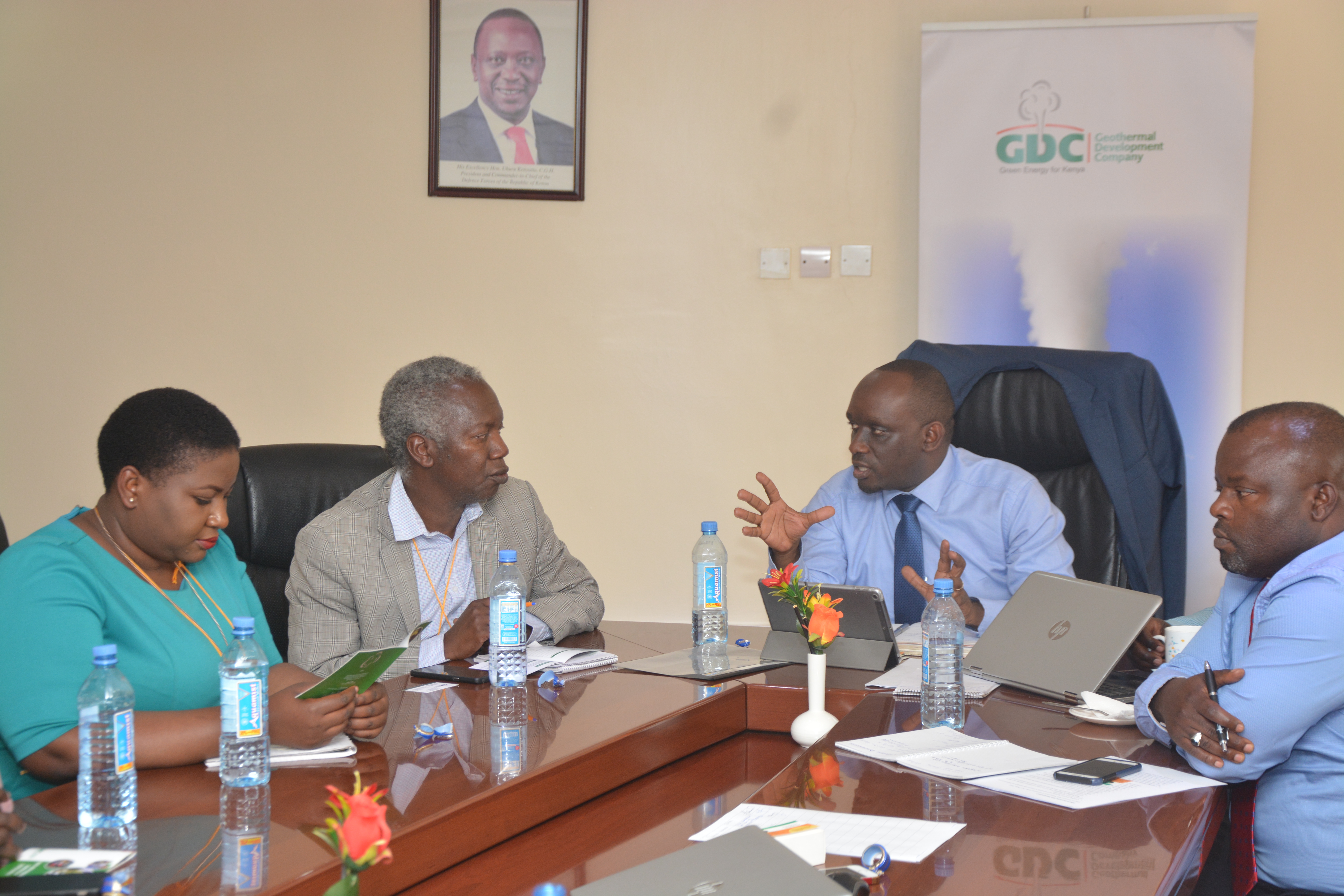
Nairobi, a chilly November morning. The Paka CLMC visits GDC headquarters. The boardroom is warm with laughter and appreciation. The committee is here to extend its thanks.
Ms. Cheptoo delivers the closing sentiment: “Thank you MD and all the GDC people. The land registration is the best gift you have given to us. I can assure you that life will never be the same again. The title deed will bring prosperity to the people.”

At last … GDC Board of Directors Chairman Hon. Walter Nyambati (right) and GDC MD & CEO Mr. Paul Ngugi (left) present a title deed to Mr. Jacob Ngolietang, Chairman of the Paka Community Land Management Committee, at the KAWI House offices