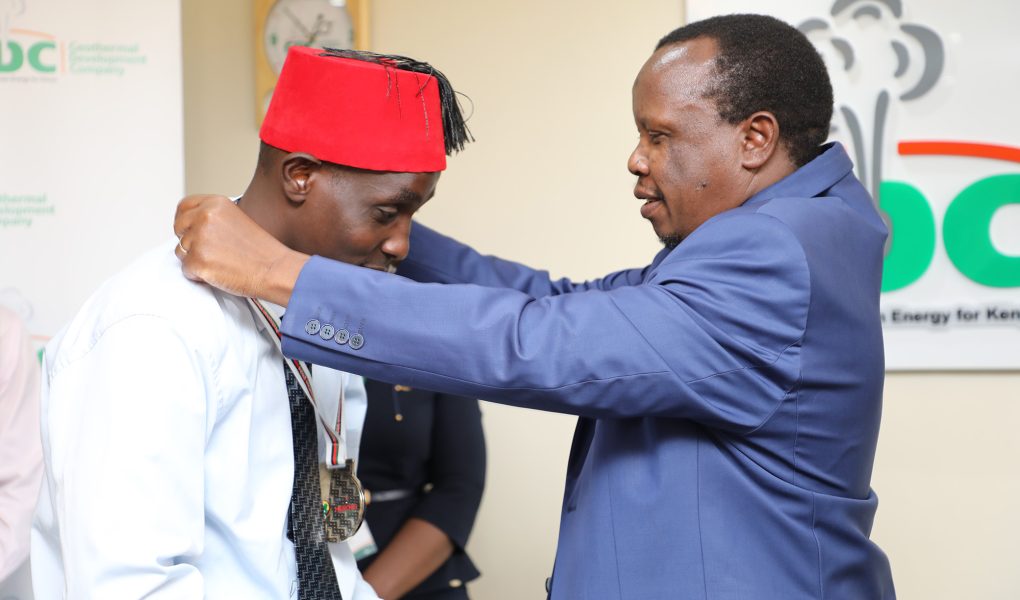
Hassan Intalo is soft spoken, almost shy. Yet, deep inside, he is determined, selfless, and community-centred. The Environmental Scientist in GDC’s Safety, Health, and Environment department is a man on a critical mission. His years of quiet service in Tiaty, Baringo County, mentoring students and championing education, finally earned him national recognition. During the 2024 Mashujaa Day, Hassan was conferred the National Heroes Award (Philanthropy Category) by the President, H.E. Dr. William Ruto – a reward for tireless commitment to community service.
“I received a text on September 31, 2024, telling me that I had been feted with the National Heroes Award. At first, I thought it was the usual phishing,” Hassan recalls with a laugh. He turned to his brother, who works with the Ministry of Interior & National Administration, for confirmation. Reassured that such honours were indeed legitimate, he still approached the news cautiously. He quietly asked a friend in the Corporate Communications department to take the high-resolution photo the message had requested for his profile – but insisted it be kept hush-hush. “I wasn’t sure if it was real or a prank,” he admits. It was only after checking the official list online and spotting his name that the news finally sank in.
Hassan’s journey began far from the limelight, in the quiet village of Chemolingot in Tiaty, Baringo County. Like many from such places, his early education was modest but critical. “I went to Maron Primary School in Chemolingot. To me, school was good – I got the education I needed,” he says. Still, the approach to learning at the local primary school was more laid back.
Still, Hassan excelled in his exams. He secured a slot at Moi High School, Kabartonjo. This would be a turning point in his life. “It was in secondary school that I realised something was amiss. At Kabartonjo, the facilities, the teaching – everything was different. Serious. Students took the initiative to study ahead. Teachers were serious and supportive. It wasn’t that our primary teachers didn’t care- they just lacked the resources and support system. I grieved for my village mates who missed out on the same exposure,” explains Hassan.
Academic culture
Hassan had always enjoyed studying. Math and sciences drew him in, with physics taking his heart. At Kabartonjo, supported by a structured learning system and a more engaged academic culture, his performance steadily improved. Yet even as he embraced this new environment, he couldn’t ignore the stark contrast with his peers in the village. “Here I was, benefiting from resources and support, yet I knew my peers didn’t have the same opportunity. And honestly, that hurt,” he reflects.
Unwilling to move on and leave others behind, Hassan felt a strong urge to act. It was this conviction that drove him to begin coaching students in his home area during the school holidays. “I excused myself from holiday tuition at my school so that I could study with my compatriots at home,” he explains. It was a sacrifice—but not one he regrets. “The only thing that increases when shared is knowledge,” he says. “I would tutor my peers during the day and study at night.” That spirit of service and empathy, fueled by education, quietly set him on the path to becoming a national hero.
After high school, he continued this effort, visiting schools to coach students on study skills that could help them grasp and retain knowledge more effectively. Today, Hassan takes pride in seeing some of his former mentees pursue university education and others already working -tangible proof that the seeds he planted have taken root and are bearing fruit.
Community needs
Later, at Kenyatta University, Hassan pursued a degree in Environmental Health – once again motivated by community needs. In 2009, there was a cholera outbreak in Baringo that left a deep impression on him. “I knew I had to do something. That’s what led me to study preventive medicine – to offer solutions that would stop such suffering in the future.”
Before joining GDC, Hassan also volunteered with local health facilities, often lending his support during public health campaigns. Whether it was mobilisation for immunisation drives or spreading awareness on preventive health, he was always willing to help. Today, he continues to train students on proper sanitation practices and environmental conservation as a way of promoting both human and environmental health. His efforts are geared not only at reducing diseases but also at shaping a generation that understands the link between a healthy environment and a healthy community.
Over time, Hassan’s quiet acts of service evolved into bigger initiatives. As a mentor at his alma mater, Moi High School Kabartonjo, and at Chemolingot Secondary School, he consistently invested in the academic and personal growth of students, having mentored at least 120 students so far. He would later step in as the pioneer Principal of Chemolingot Day Secondary School, where he lobbied for its official registration and the deployment of Teachers Service Commission staff. His mentorship efforts, often in collaboration with other institutions and volunteers, have had a palpable impact on education in Tiaty. Eventually, a local community member nominated him for the National Heroes Award, which was confirmed after thorough vetting by the National Heroes Council.
But it’s not just the big wins that define Hassan’s work – it’s the lives he’s touched. Maxwell Kaspan, now working in Nakuru, recalls: “he (Hassan) wasn’t just a teacher – he was a mentor in school and in life. We lived together. His thoughts and guidance carried me through those four years.” Fellow volunteer Chris Kotokin adds, “Volunteerism is a calling, and Hassan always went beyond the call. He laid the foundation for the school to run. I’m proud of his achievement.”
Indeed, Hassan’s role in ensuring that education becomes a tool for breaking the cycle of poverty goes beyond mere access; it emphasises empowerment – teaching students that they are the architects of their own future.
A recent moment that deeply touched him was a special invite for a tête-à-tête with GDC Managing Director and CEO Mr. Paul Ngugi. “I never imagined such a day would come in my life,” he says softly. “It was my first time at Kawi House, my first time in the CEO’s office. I felt honoured, deeply appreciated. That moment meant a lot – it told me my efforts were seen, that I was not walking this journey alone. The meeting with Mr. Ngugi boosted my spirits,” he recalls.
So, is it all work for Hassan? Not quite. He enjoys cycling in his free time to stay fit and maintain a good mental state. “If I’m not working, I cycle for my fitness. Cycling motivates me to remain fit and of sound mind. I also love listening to Jamaican reggae, especially Lucky Dube’s tunes,” he says.
A typical day begins at 5:00 AM with prayers, browsing the dailies, and preparing for work. Later, he proceeds to the Menengai Geothermal Project to conduct Safety, Health, and Environmental (Noise Monitoring and Assessment) activities inside and outside the caldera.
Hassan’s mentorship programs are scheduled in advance and typically carried out during weekends. He also dedicates his leave days to mentorship. Between his busy schedules, Hassan is also an Information Technology enthusiast with an interest in programming and networking. “Information technology and data are the big things. I immerse myself in that space to embrace and change with it.”
He envisions a thriving Tiaty where education, environment, and health thrive. His story serves as a powerful reminder that change doesn’t have to start big – it just needs to start somewhere. And for Hassan Intalo, that “somewhere” was home.


