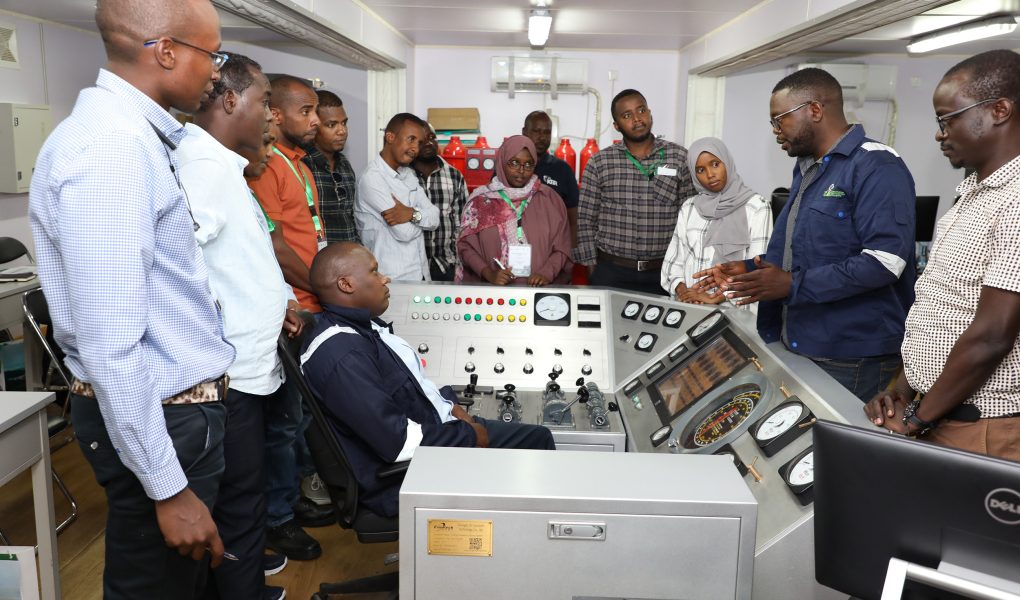
On January 22, 2024, the Geothermal Development Company (GDC) hosted a special delegation at Paka Hills. At one of the towering drilling rigs, the guests marveled at the imposing machinery. As they approached a well gushing with super-heated steam, a spontaneous moment unfolded—each visitor instinctively reached for their phone, capturing photos amid the thunderous roar of steam escaping under immense pressure.
The delegation, from Tanzania’s national electricity company TANESCO, and its geothermal counterpart, Tanzania Geothermal Development Company (TGDC), had come to witness Kenya’s advances in geothermal development firsthand. But beyond observation, they were here to learn—exploring GDC’s technical prowess with hopes of applying the lessons to Tanzania’s fledgling geothermal sector.
This visit is far from unique. GDC’s projects at Paka, Silali and Menengai have become pilgrimage sites for African delegations, attracting a steady stream of interest from policymakers, investors, researchers and energy officials. As Kenya’s geothermal story spreads across borders, so too does its influence. And in that quiet expansion lies a potent force: Geothermal as soft power.
Indeed, geothermal is becoming an unexpected pillar in Kenya’s diplomatic toolkit. As Harvard scholar, Prof. Joseph Nye, famously put it: soft power is “a means to success in world politics.” And while it might not generate headlines like trade pacts or state visits, geothermal power is doing quiet, consistent work in enhancing Kenya’s image abroad.
Impressive
Tucked away in remote, sun-scorched volcanic zones, Kenya’s geothermal operations might seem peripheral. But they are, in fact, at the centre of the global green energy conversation. With a current installed capacity of 985 MW—making up nearly 45 per cent of the national electricity supply—Kenya ranks sixth globally in geothermal power generation. An impressive 93 per cent of the national grid is now powered by renewable energy, with geothermal as its anchor. In the arena of environmental diplomacy, this gives Kenya rare credibility.
The country has also built one of the continent’s most advanced policy and investment environments for geothermal development. It remains the only African nation commercially exploiting the resource at scale. State investment has been significant, and the private sector has poured in billions, especially in power plant development (see The Last Word). Beyond electricity, GDC is actively pioneering direct-use applications—using geothermal heat in industrial processes and greenhouse farming.
This comprehensive ecosystem— technical, financial and regulatory—has made Kenya a natural choice for capacity building in Africa. Each year, hundreds of students, investors, and energy officials travel to Kenya for benchmarking missions and training. One of the continent’s flagship knowledge-sharing platforms is GRO-GTP (formerly under the UNU umbrella), co-led by GDC and KenGen. This programme brings in around 45 fellows annually from 13 African nations, enhancing Kenya’s regional leadership in geothermal.
“Apart from the annual training, GDC also offers tailor-made courses to different countries depending on their needs,” explains Dr Robert Ogutu, Acting Manager of the GDC Centre of Excellence (GCE). “It gives us immense fulfilment to see countries turning to Kenya for geothermal expertise.”
As Kenya marks 60 years of diplomatic engagement, the country’s geothermal leadership adds a distinctive, high-impact layer to its soft power portfolio. While the world may know Kenya for its elite runners, rich coffee and unforgettable safaris, geothermal energy is now a critical and increasingly visible export—an ambassador in its own right.
From the depths of the earth, Kenya is not only generating clean, reliable energy—but also forging bonds, shaping perceptions, and defining leadership in Africa’s energy transition.


